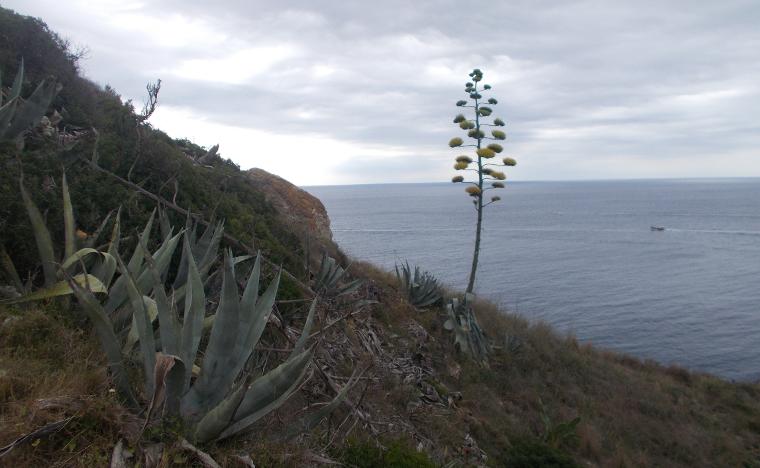
The agave that grows wild in the rocky coastline near my house. It was first introduced to provide the fibres of sisal to make ropes for the nearby port. It is an amazing plant that has been exploited in many ways and for many years in the American continent. The main body of the plant is rich in a sugary syrup and in Mexico this is used in the production of Tequila. The Mescalero Apaches used it to make their drink Mescal. The base of the leaves can be pounded to produce a type of flour for bread making. In times past the large sinewy leaves were used for thatching roofs. The plant lives for 15 to 20 years or so then throws up a flower stalk to produce hundreds of seeds. As the flower stalk withers, so too does the mother plant. Often there are side shoots around the main plant but the central piece dies. The stalk dries and hardens on the outside while the inner core becomes soft and porous. In desert areas it may remain standing for several years. Here on our windswept Costa Brava it usually yields to the wind and falls over. You can see this in the photo above. This tall stalk is suited at its thinner end for making bass flutes, the middle parts for Apache fiddles and the thick base for making drums. It is understandable how many people savour the mystique of a plant that dies but lives on in music. There are several species of Agave and its common name changes according to the species and ethnic location. Here in Spain it is called "pita" while most English speaking people call it "the century plant". It is also known as mescal cactus or tequila cactus although it is not in fact a cactus.